Stub it, test it
* Due to the thesis’s confidential nature, it cannot be explained in detail.
Well, I can’t tell much about the concrete details of this exciting Bachelor thesis project I did at the Rabobank. Why not? Because the bank’s payment systems have utmost confidentiallity. However, like any bank, a high volume of booking requests have to be handled. A payment-processing architecture has developed over time, primarily running on an established mainframe environment. Within this architecture, the team I was part of oversees a system responsible for validating and routing requests to different downstream services. One key service of this system handles larger batches of booking requests.
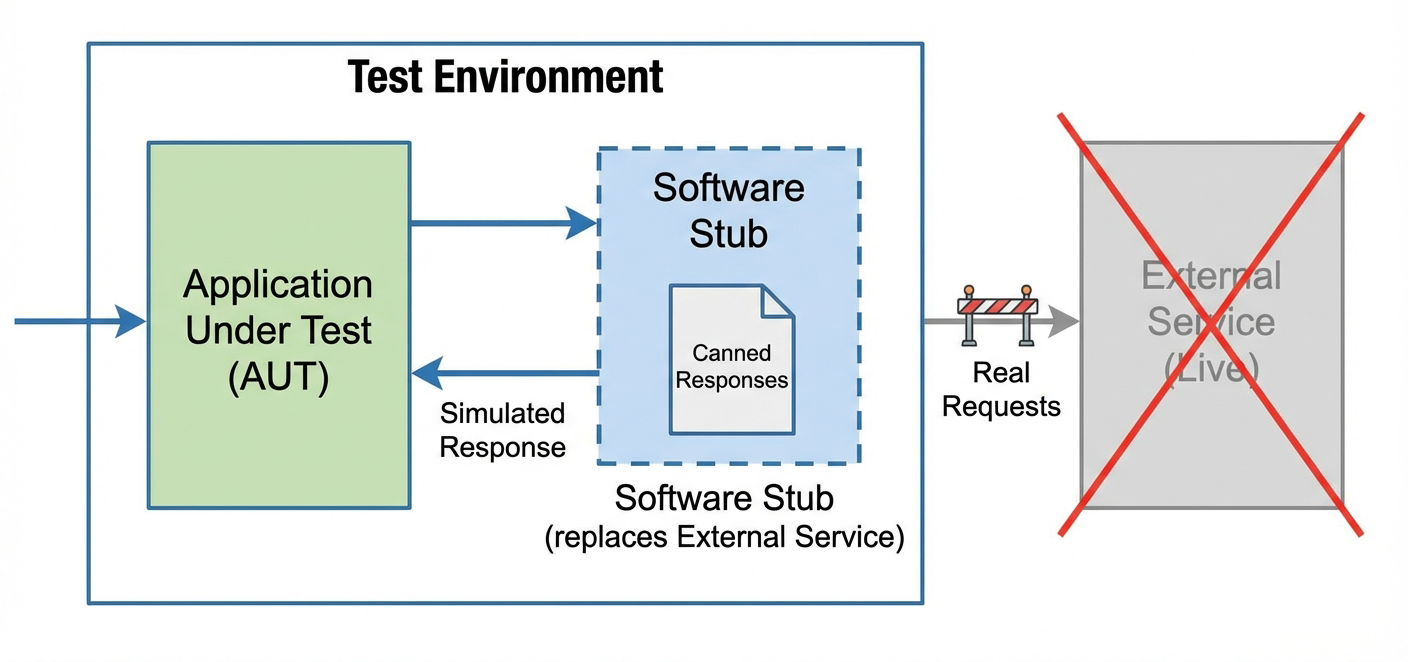
These batches are then sent to an external service for further processing. Since that external service is managed by a separate team, the testing process can be slow and sometimes inconsistent, due to data constraints and the need for cross-team coordination. To address this challenge, a stub has been proposed to replace the external service during testing, allowing for faster and more controlled validation of the batch-booking functionality. This is standard practice in enterprise software. How can such a stub be created so that it isolates the batch-processing system and makes it testable, without requiring communication with the actual external service. This was the guiding question in my research.
To answer this question, I researched mainframe technologies, details of the batch-processing system, and the interfaces. Additionally, qualitative interviews were conducted with the tester and business analyst, to understand the requirements and motivations. Based on these findings, a stub was designed, implemented, and tested to verify that it can effectively mock the external service.
Results and Conclusion
The implementation successfully met the research objectives.
- Isolation: The batch service can now function independently of the savings environment during the System Test phase.
- Control: Testers can determine specific outcome scenarios (OK/Not OK) by modifying data in the stub table rather than relying on external data sets.
- Reliability: The solution eliminated false negatives caused by external data changes and reduced the wait time associated with cross-team dependencies.
The research concludes that implementing a mainframe-native stub using the “Stub Boss” design pattern is a viable and effective method for isolating critical payment services for testing purposes.